
Reclaiming the lifeworld is the key to the Sophrology method where individuals can discover their own untapped reserves and inner resources and awaken their inner senses to direct their own recovery towards wholeness and wellbeing. So effective is this method that it is practiced today by leaders of sport and business as well as individuals from all walks of life, including pre and post-natal mothers.
After training as a Sophrologist with the Energy Centre, Sarl, Switzerland, I introduced Sophrology to a group of Learning Unlimited students. The most marked shifts occurred with students who had severe exam anxiety and those who needed to be assisted with enhanced learning strategies. An interview with Pippa Hudson of Cape Talk provides a more in-depth discussion about Sophrology, what it is and how it can be used to enhance wellbeing.
These benefits encouraged me to take this further to rural communities where we researched the impact of introducing Sophrology to 30 ECD teachers from different ethnic and cultural backgrounds. Based on the pilot an application for the recognition of the program by SACE was approved and since then it has been adopted by the Western Cape Education Department as a part of its teacher development program.
Some of the benefits in the rural communities were increased self-confidence and self-awareness, development of tolerance and empathy and a shift from victim mentality to one of empowerment and agency.
Report on Sophrology Training in McGregor, 2022 – 2023
by Barbara Jones
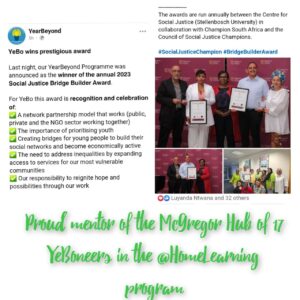
I have conducted Sophrology training at the Breede Community Centre in McGregor, during 2022 and 2023, to young people who are on a one-year post-school educational and training programme; the YearBeyond (YeBo) programme. YearBeyond is described as a ‘Youth Service partnership between Government, the National Youth Development Agency, donors, and NGOs. Initiated in the Western Cape, YearBeyond is a national programme that provides unemployed youth (18-25 years old, called Yeboneers) with meaningful work experience and a pathway to further studies or work, while at the same time encouraging a culture of community service.’[1] In McGregor, the Yeboneers participate in what is called the @HomeLearning Programme, where they are placed as teacher assistants, providing assistance and support in local primary schools for children up to grade 3 who are struggling to keep up and are at risk of dropping out of school.[2]
I was asked if I would run sophrology training sessions for the first group of Yeboneers in 2022, as part of their personal development on the programme, specifically to assist them with anxiety, emotional disturbances and poor self-confidence related to their impoverished socio-economic circumstances. After discussions with the training coordinator at the Breede Centre, Lammie Ferreira, I adapted the sophrology training programme for educators that has been accredited by the South African Council for Educators (SACE), to better suit the needs of the McGregor group. A major change was to shorten the programme to 8 sessions instead of the 10 sessions approved by SACE, and to simplify the concepts and the training[3]. With each one-hour training session the participants were provided with a sound recording of the sophrology exercises we had done in class, to practice in their own time.
There were 7 Yeboneers who participated in 2022 and 17 in 2023[4] and the weekly sessions were one hour – all that their timetable can accommodate – on Friday afternoons from 14h00 to 15h00. The training took place in the second half of the year and most sessions ran in concurrent weeks, except for occasional interruptions to the schedule. Because of the short time available for each session, it was not possible to have any meaningful discussion with the participants about what they feel during the exercises, and the check-ins at the beginning and end of each session were, of necessity, very brief.
They were encouraged to write in their journals for 5 minutes at the end of every session about what they had experienced, but for privacy reasons I did not get to read these. Committing their experiences in writing is an essential part of the training, and I do think that an online resource where they could record their comments and insights would be very beneficial – both to the participants and for me as the facilitator, to measure the effect of the training and how it could be improved. It would need to be a very simple app that they can access on their phones where they respond to 2 or 3 questions each time after they have completed a practice exercise.
Having learnt what worked well and what could be improved from the 2022 training, I amended the programme further for the 2023 cohort. In particular, in the last session this year we explored how the Yeboneers could use some of the exercises in their roles as educators, and I included some sophrology ‘ludique’ exercises that might be appropriate for young children. I wrote up all of these exercises as a ‘toolkit’[5] that the Yeboneers could draw on, and as a basic resource to assist their Sophrology practice.
Certificates were given to each Yeboneer at a formal ‘graduation’ event at the end of 2022 and 2023[6], which they greatly appreciated. With the small 2022 cohort it was easy to see who was committed to the sophrology programme and gaining benefit from it, and to encourage them to practice between sessions. It was also possible to work with the energy of the group, and there was one particular session – the sleep exercise session – where the magic really happened and we were carried by a powerful energy flow. I did find it much more difficult to get positive energy flowing with the large 2023 group than with the more intimate 2022 group, and also to connect with individuals in the larger 2023 group. Also, a disappointment that I experienced with the second cohort was that very few of them practiced the exercises between sessions, although there were a few who did so and who reported experiencing the benefits.
Overall, I feel that the Yeboneers benefited from the sophrology training and most of them attested that they were sleeping better and feeling much ‘calmer’ as a result of the training. The training coordinator, who attended all the 2022 sessions, has been very enthusiastic about its benefits and reported that she has seen marked improvements in the behaviour of many of the students. She said that, for the majority, it has been the highlight of their week and they had expressed disappointment on the weeks when there were no sophrology sessions.
What I consider to be the biggest obstacle is that I am facilitating the sessions in English whereas the participants are Afrikaans speaking. The training coordinator insists that this is not a problem as the Yeboneers are all sufficiently fluent in English. However, they do communicate with each other in Afrikaans and they clearly feel awkward discussing their sophrology experiences in English, especially in front of their peers. This means that I receive very little feedback from them and it is an obstacle that we need to address. One way would be for me to become more fluent in Afrikaans, but perhaps a more viable alternative in the long term would be to train someone from the local community as a sophrologist, whom I could mentor and work with to deliver the training.
I am assured by the skills training coordinator that the sophrology training will be definitely needed again for the 2024 cohort, and that she may call upon me to conduct sessions for another group of youth in skills training as well. I greatly enjoy working with these young people and feel privileged to be able to assist, but if this work increases it might be wise to position the training more formally and strategically as a TILE programme, rather than just as a one-person, voluntary offering.
Barbara Jones
24 January 2024